







Students improperly required to identify parent citizenship status on district form – until The Mesa Legend asked questions


When Penelope Medina saw the question, she paused. A knot twisted inside her stomach as she peered down at what she had expected to be just another mundane financial aid form.
It required her to identify the citizenship status and residential history of one of her parents.
Uncertain, the 20-year-old college student called over her mother, who joined in the confusion and both agreed to stop completing the document in fear that the information could be used against them or their family.
The fear that Medina and her family felt was not isolated, rather it reflected a broader fear around how citizenship information is used nationwide.
“I think it does have an effect of discouraging applicants,” said Eduardo Casas, a staff attorney for the Mexican American Legal Defense and Educational Fund (MALDEF). “Just because there’s a lot of fear to even just put something, someone’s name down on these forms.”
But after The Mesa Legend started asking questions about why citizenship information was being requested from students, the Maricopa County Community College District (MCCCD) revised the form. Now, the question is “optional,” though the district has yet to explain why the question is still being asked.
Medina, an editor with The Mesa Legend, discovered the form while researching why she was being charged out-of-state tuition despite living her whole life and graduating from high school in Arizona.
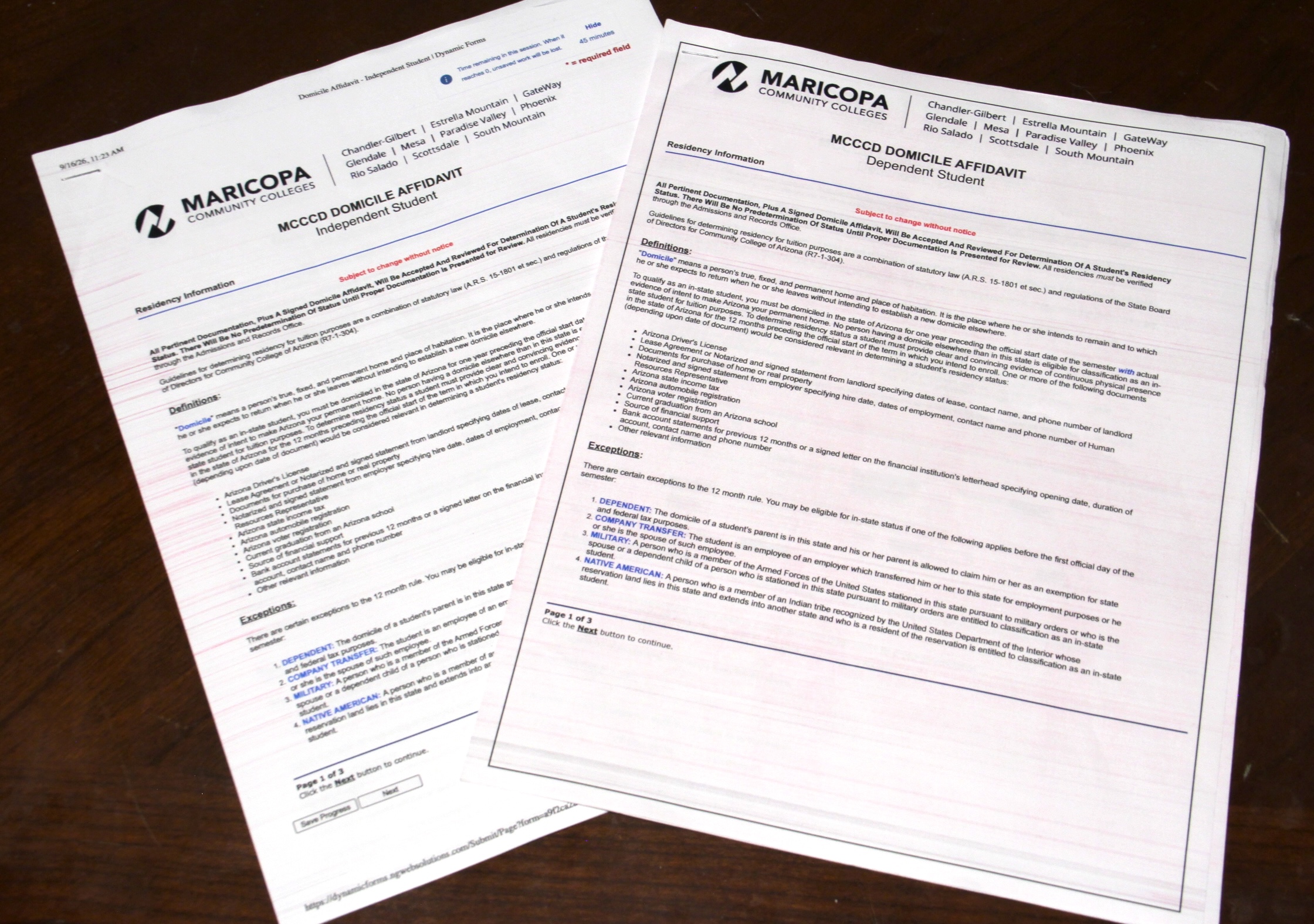
The Domicile Affidavit is used to determine the residency of a student for tuition classification purposes. The form has two versions, one for students with dependent status and one for students with independent status.
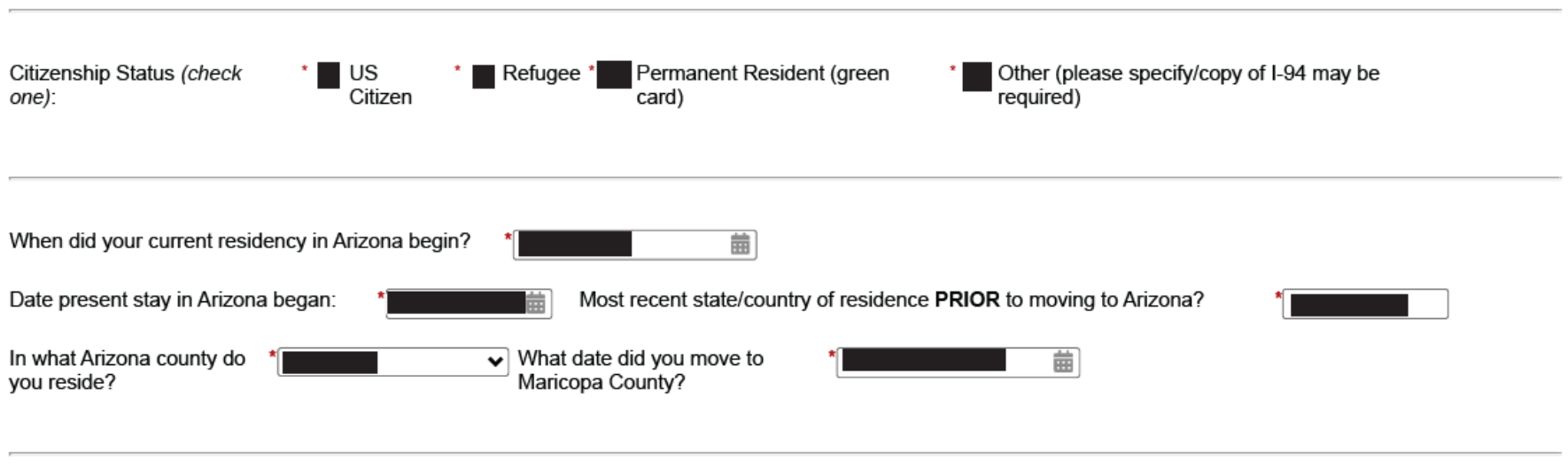
Both versions of the form ask students to identify citizenship status. While students with independent status are asked to identify their own status, dependent students are requested to identify the citizenship of a parent, legal guardian, or spouse.
U.S. citizenship is not required to be admitted to an Arizona university or community college, nor is citizenship needed to qualify for in-state tuition classification.
The only case in which it is necessary to identify citizenship status is when a non-citizen has some temporary status that would affect if they are granted in-state classification, such as a B-1 visitor visa.
Medina asked about the affidavit to Mesa Community College (MCC) Admissions and Records interim student services supervisor Rebekah Ward, who claimed that the four-paged affidavit does not ask for citizenship status.
However, after having the dependent version of the form shown to her, Ward gave a contradictory answer.
“That doesn’t go into play in determining whether or not you receive in-state tuition or not,” she said. “We can’t question what a parents’ [citizenship] status is in the means of you trying to establish residency here.”
In a follow-up interview with The Mesa Legend, Ward along with MCC Dean of Enrollment, Dana Frasca, said that although the affidavit asks to identify citizenship status, that information is never checked or followed up on.
Yet, neither Frasca nor Ward could give an explanation as to why the question is included if the information is not used, and could only cite that it was a district form outside of their jurisdiction.
The Mesa Legend contacted Maricopa County Community College District for comment, however reporters were redirected back to the MCC’s public information officer, who asked for direct questions that could be sent to the district.
After being provided with these questions, the district did not respond with any contact information for someone who could give answers about why the citizenship question was on the form.
Unknown to The Mesa Legend at the time, the Domicile Affidavit had already been quietly changed to make the citizenship question “optional” in order to complete the form.
When The Mesa Legend reporters began investigating, a sequence of events unfolded regarding the affidavit and how administration responded to questions related to the admissions process.
It was Aug. 31, 2026 when Medina saved her original half-completed form. On Sept. 11, The Mesa Legend requested an interview with MCC Dean of Enrollment and the Admissions and Records department to talk about the affidavit.
Just four days later, Sept. 16, Mesa Legend reporters downloaded their own copies of the form, not knowing that it had been recently revised. In the new versions, the citizenship question was no longer marked as required and another question had been outright removed.
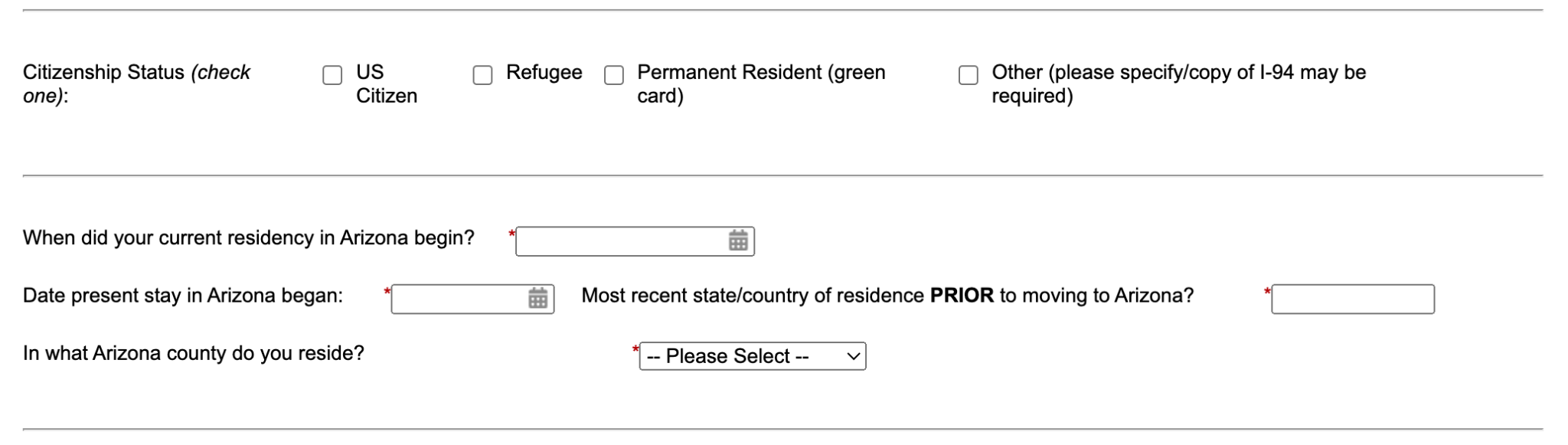
The interview with Ward and Frasca happened a day later, on Sept. 17, with The Mesa Legend still unaware that the affidavit had been changed without notice.
The silent and sudden change to the form only adds to the question of why knowing the citizenship status of a student or their parent was even required in the first place, especially if that information was never questioned.
The MALDEF attorney, Casas, stated that while the college administration may trust themselves to properly handle sensitive information, that standard of trust does not always extend to the people who have to disclose that information.
While the staff attorney couldn’t speak on whether there was an increased risk of sensitive information being shared in regards to the Domicile Affidavit specifically, Casas did explain that states have a lot of discretion with how they use collected information.
He noted that several precedents already exist, such as in California, where the state legislature approved a plan allowing their Department of Motor Vehicles to share drivers license and identification card information with a national verification network run by the American Association of Motor Vehicle Administrators.
Concerns centered around whether federal immigration authorities could gain access to the network by asking local officials to make requests on their behalf. These concerns are not without cause as Immigration and Customs Enforcement (ICE) has routinely accessed Flock’s national automatic license plate reader system through using local authorities as proxies.
“Generally there is a pressure from [the] Trump administration to try to get information from the states, and each state has its own legal framework and political, I guess, will to abide or resist,” said Casas.
He also mentioned that the citizenship question might be related to a political movement which seeks to redefine who has access to public assistance.
“There is generally a push for restricting what’s called public benefits to non-citizens,” stated Casas, “the idea is that certain people are less deserving of these benefits, and [that] conceivably could be something like in-state tuition rates”
The staff attorney explained that this political push to restrict who has access to public benefits often puts students in a tough spot and forces them to consider if their education is worth potentially putting loved ones at risk.
“[People are] faced with that question: will my parents be deported by my pursuit of higher education, which is also my key to be able to support my family oftentimes,” said Casas.