



Monarch waystations at MCC aim to conserve butterfly populations
The monarch waystations at Mesa Community College grow native plant species year round to provide nutrients for North American monarch populations migrating through the Southwest and encourage students to engage with local conservation efforts beyond the campus.
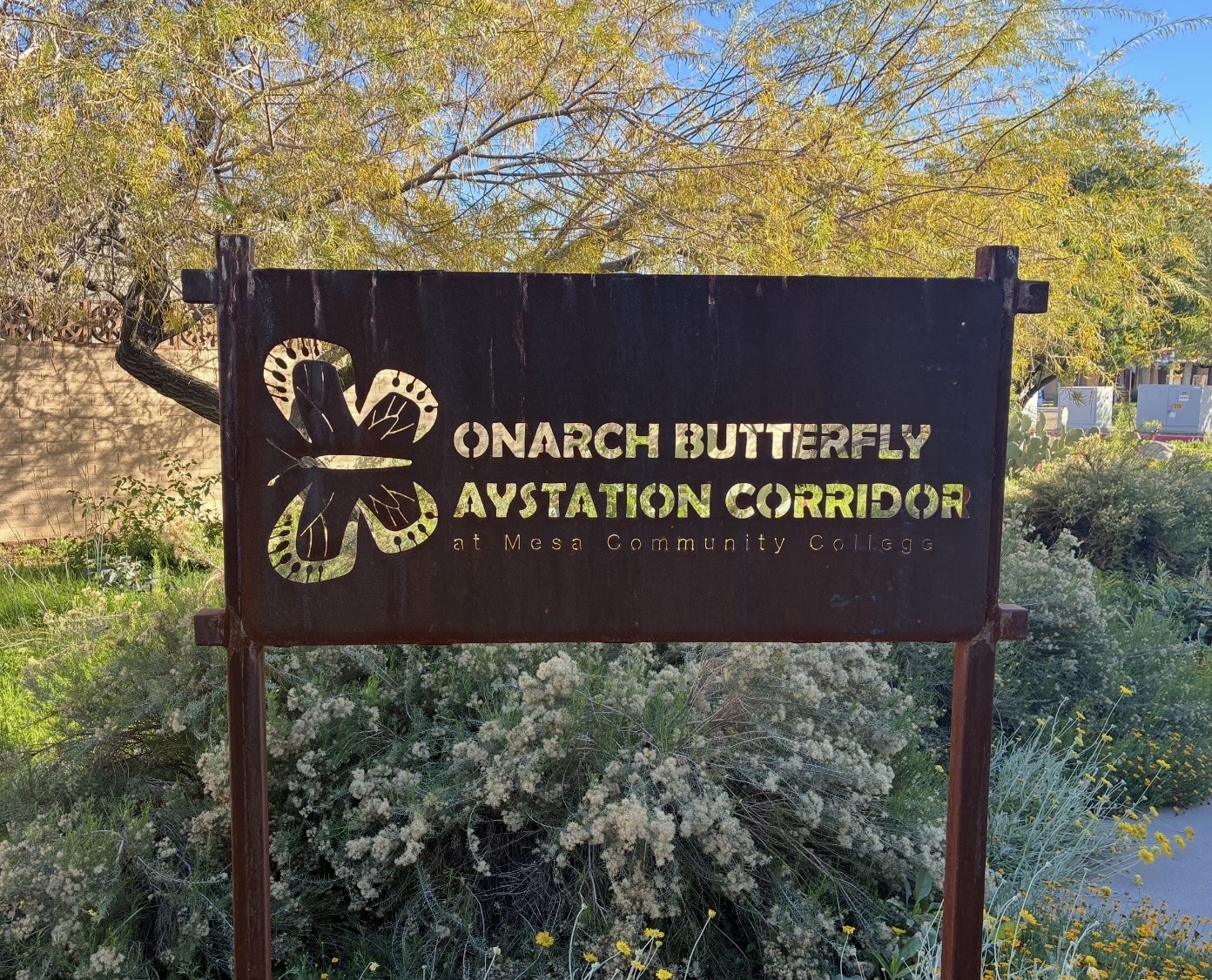
MCC’s Southern and Dobson campus has two monarch waystations. The one near the BA building solely consists of desert milkweed. The other waystation nearby the HW building is filled with tropical milkweed and other desert flowers.

“The basic goal of monarch waystations is to create habitat,” said Natalie Melkonoff, plant and insect ecology program manager at Desert Botanical Garden (DBG). She primarily researches the interactions between monarchs and milkweed at DBG.
According to Melkonoff, there are around 30 species of milkweed throughout Arizona and 70 species across the U.S. Through her research, she said both desert milkweed and tropical milkweed have shown to be good host plants.
Melkonoff said waystations like the ones at MCC provide critical resources for monarchs, such as nectar for adults and milkweed where they can lay their eggs on. Once those eggs hatch, the caterpillars will feed on the plant as their main food source.

Events and community engagement with the waystations
Choeun Lim is the sustainability lead at MCC’s Center for Community and Civic Engagement (CCCE). She said the CCCE maintains the monarch waystations in collaboration with Southwest Monarch Study (SMS).
“Civic engagement as a broad term just means to get involved with the community and to help out the community. I feel like the waystations sort of fall under that because the environment is also part of the community,” Lim said.
Every semester, the CCCE will host monarch tagging events for the public. They then send the tracking data to SMS to help them calculate monarch populations during migration.
“We basically go to the waystations when the monarchs are migrating and we’ll gently grab them in nets, take their wings, and put little tracking stickers on their wings,” Lim said. Because of climate change, she said the CCCE hasn’t been able to do a tagging workshop during the fall 2025 semester.
Lim said normally the monarchs migrate around November, but rising temperatures are making it harder for them to migrate. Their migration is now happening closer to December and January. The CCCE still plans to do a monarch tagging workshop next semester with SMS, she added.
How seed balls play a vital role in monarch conservation
The seed ball workshop is another event tied to the waystations that has been going on for several years now. The concept of the workshop was created by members of the CCCE to coincide with the waystation’s conservation efforts, Lim said.
Lim was in charge of planning the events for the seed ball workshop during the fall 2025 semester. She said the seed ball workshop usually takes place under the clock tower. Every semester, the CCCE will set up some tables with all the materials needed: clay, soil, shredded newspapers, native seeds, water, buckets, and mixing tools.

“The process of making the seed balls isn’t very difficult and it’s not very time consuming either,” Lim said. “We wrap them up into little packaging and then we’ll give them out during other events.”
The CCCE does not have any upcoming seed ball workshop events as of now. Lim said the most recent workshop was held on Oct. 18, 2025, in order to prepare some seed balls to give out during MCC Dance’s “Flight: A Mariposa Story” performance.
“It was a really positive interaction from the community. Everybody who came thought it was really cool,” Lim said. “They were really excited to make some seed balls, and everybody who takes seed balls is always really excited to plant them in their gardens and help the monarchs.”
Anybody can volunteer at the seed ball workshop or visit the CCCE’s office to request a pre-portioned material kit they can take home, Lim said. Typically there will be flyers around campus for any upcoming workshop events. There is also a digital monthly newsletter people can sign up for in the office.
Why planting native is important for waystations
“A waystation is really just a fancy word for an area that happens to have these plants here, so it’s just a butterfly garden,” Lim explained. “If it has milkweeds, plants that give nectar, and some sun and shade then it could be a waystation.”

Since the college’s waystations use mostly native plants, they are well-accustomed to the desert and require fewer resources. While drought affects every plants’ ability to sprout, Melkonoff said even the smallest amount of rain in the desert can help them rebound.
“Native plants are going to do better here, so they’re going to be healthier than a non-native one and have a better host quality for monarchs,” Melkonoff said, “but anything is a good host plant as long as it survives well or makes a good nectar source.”
How community gardens can help with monarch conservation
Beyond what the waystations on campus achieve, students with limited garden space can volunteer or rent a plot bed year round at Mesa Urban Garden (MUG) to help plant more pollinator flowers for migrating monarchs.
“We have the tropical milkweed, which seems to be where I see most of the butterflies,” said Laurie Blitz, garden coordinator at MUG. “We also have Gregg’s blue mistflower, which is a monarch magnet.”

The community garden started back in 2012 and was built entirely by volunteers just four miles east of MCC. They have their own registered monarch waystation aside from the herbs and vegetables that grow in most of their plot beds.
“Anybody can volunteer, I just take their names down and then I’ll put it on our Facebook page,” Blitz said. According to her, MUG can offer up to 10 hours of volunteer work per week.
Facebook is also where all of MUG’s upcoming volunteer events and activities will be posted. Spreading wood chips around the garden or rebuilding the garden beds are just some of the tasks that volunteers can do, she said.
Students can visit MUG’s website to find more information about volunteering or renting a garden bed. While there are many other ways to contribute to monarch conversation, it often starts with a basic butterfly garden.

“Waystations allow us to learn about nature, which we kind of hope inspires people of all ages to care more about nature and to think more about conservation,” Melkonoff said.